

Blog

- Jack Shepler
- Jul 02, 2026
AI technical debt is becoming one of the biggest operational risks inside modern organizations, and most leadership teams still treat it like a future problem instead of a current one.
In 2026, companies are rushing to launch AI copilots, automated workflows, internal assistants, and AI-enhanced customer experiences without building long-term operational ownership around them.
The result is a growing layer of unstable infrastructure hiding beneath systems that still appear functional on the surface.
This concern carries real financial consequences. Research from Deloitte has found that technical debt can consume as much as 40% of an IT budget, while other industry estimates suggest that 20% to 30% of technology spending often goes toward managing aging systems and accumulated complexity. As AI becomes embedded across workflows, customer experiences, and business operations, leaders face a growing risk that these hidden costs will spread into new areas of the business.
Prompts drift. APIs change. Employees create undocumented workarounds. Nobody knows which workflows are still reliable and which ones are quietly producing poor decisions at scale.
Traditional technical debt usually breaks systems slowly and visibly. AI technical debt compounds operational uncertainty while still looking productive.
That makes it far more dangerous.
What’s Breaking Inside AI-Powered Organizations
- Why AI technical debt accumulates faster than traditional technical debt
- The operational risks leadership rarely monitors until they become expensive problems
- How “AI ownership gaps” create long-term instability
- The difference between AI experimentation and sustainable AI operations
- The 7 warning signs your AI systems are becoming liabilities
- The Appventures “AI Maintenance Map” framework
- What CIOs, IT leaders, and executives should audit immediately
Why AI Technical Debt Is Different From Traditional Technical Debt
Traditional technical debt usually comes from rushed development decisions, aging infrastructure, or short-term tradeoffs that become expensive later.
AI technical debt introduces a completely different layer of instability because the system itself changes over time.
Your AI output is influenced by:
- Model updates
- Prompt changes
- Employee usage behavior
- Third-party APIs
- Data quality drift
- Governance inconsistencies
- Workflow modifications
- Context-window limitations
- Vendor-level changes outside your control
This means your AI feature can technically remain “online” while operational quality steadily deteriorates underneath. That creates a dangerous illusion of stability.
A chatbot still answers questions. A recommendation engine still generates suggestions. A workflow automation still completes tasks.
But accuracy drops. Trust declines. Escalations increase. Manual corrections multiply across departments.
This degradation often goes unnoticed until customer trust declines, operational friction increases, or revenue begins to suffer.
The AI Integration Tax Is Getting Worse
The biggest misconception in enterprise AI is that deployment equals completion. It doesn’t.
Deployment is the beginning of a permanent operational burden.
Every AI capability you launch creates new layers of:
- Monitoring
- Governance
- Prompt management
- Vendor oversight
- Security review
- Workflow maintenance
- Human exception handling
- Output validation
This is the AI Integration Tax.
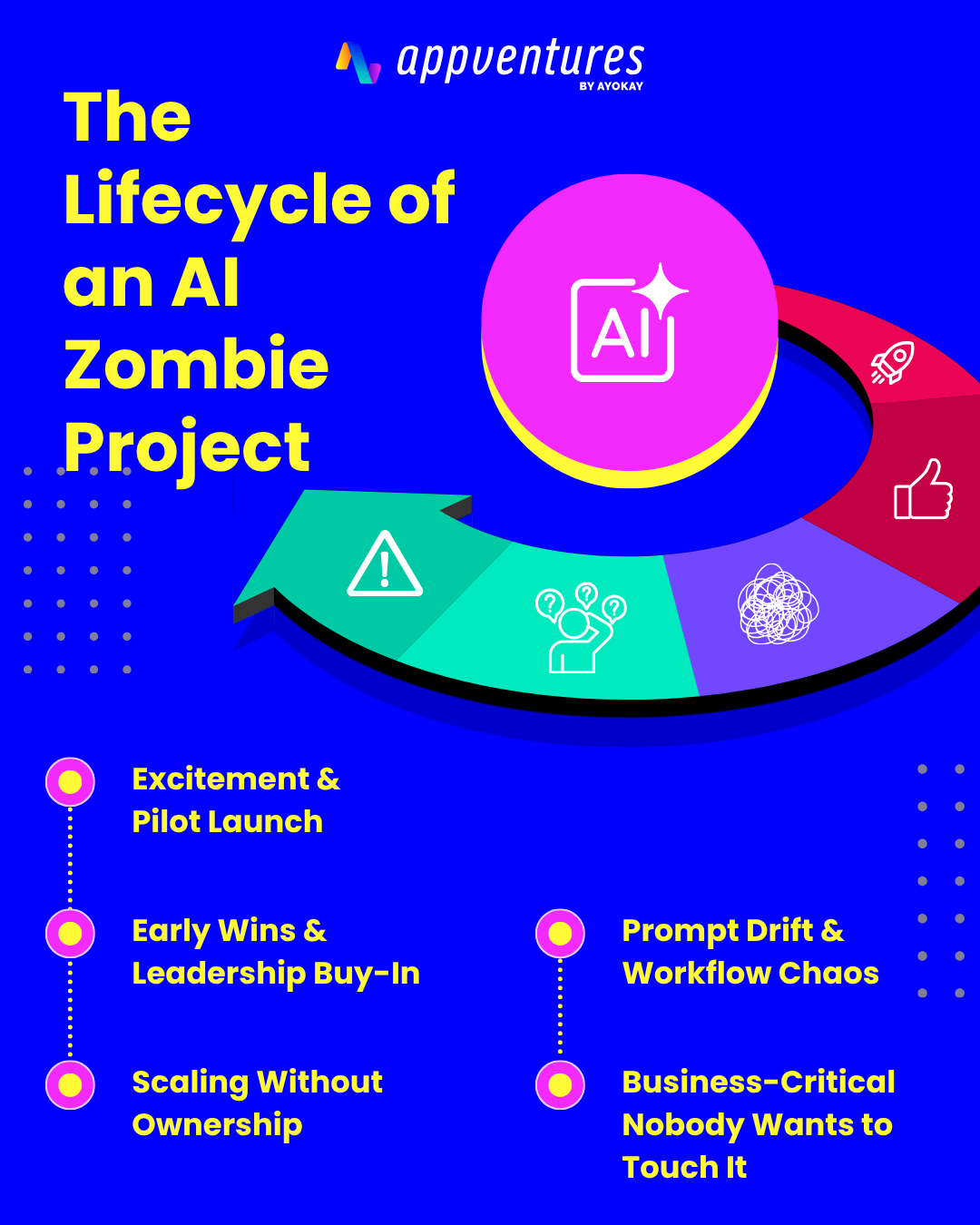
Many AI initiatives receive funding for implementation while long-term operational ownership remains undefined. That is why so many AI projects become zombie systems within 12 months.
They still exist. They still consume budget. Nobody wants to remove them. Nobody fully trusts them.
7 Signs Your AI Technical Debt Is Already Becoming Dangerous
1. Nobody Can Explain Why the AI Output Changed
If changes in AI behavior cannot be traced clearly, governance problems already exist. AI systems without explainability create operational risk fast.
2. Employees Have Started Building Manual Workarounds
This is one of the clearest warning signs. When employees stop trusting the workflow, they create shadow processes outside the system.
That means your AI layer is adding friction instead of removing it.
3. Prompt Management Lives Inside Random Documents
If critical prompts exist inside Slack messages, Google Docs, or individual employee notes, your AI infrastructure is already fragmented.
Prompt governance is becoming operational governance.
4. Your AI Features Have No Defined Owner
This is where AI initiatives often begin to lose operational stability.
The IT department assumes marketing owns the workflow. Marketing assumes operations owns the workflow. Operations assumes engineering owns the workflow.
Nobody owns long-term AI reliability.
5. Your Team Measures Usage Instead of Business Impact
High usage metrics mean nothing if:
- Error rates increase
- Escalations rise
- Customer trust declines
- Employees double-check every output manually
Activity is not operational value.
6. Your Vendors Change Faster Than Your Governance Process
Many AI ecosystems now depend heavily on external vendors whose models, APIs, pricing, and policies evolve constantly.
Your internal governance process cannot move quarterly while your AI vendors change weekly.
7. You Cannot Shut the System Off Without Operational Chaos
This is the final stage of dangerous AI technical debt. The workflow becomes business-critical before it becomes operationally stable.
Now the business depends on unstable infrastructure that has become difficult to replace, pause, or untangle.
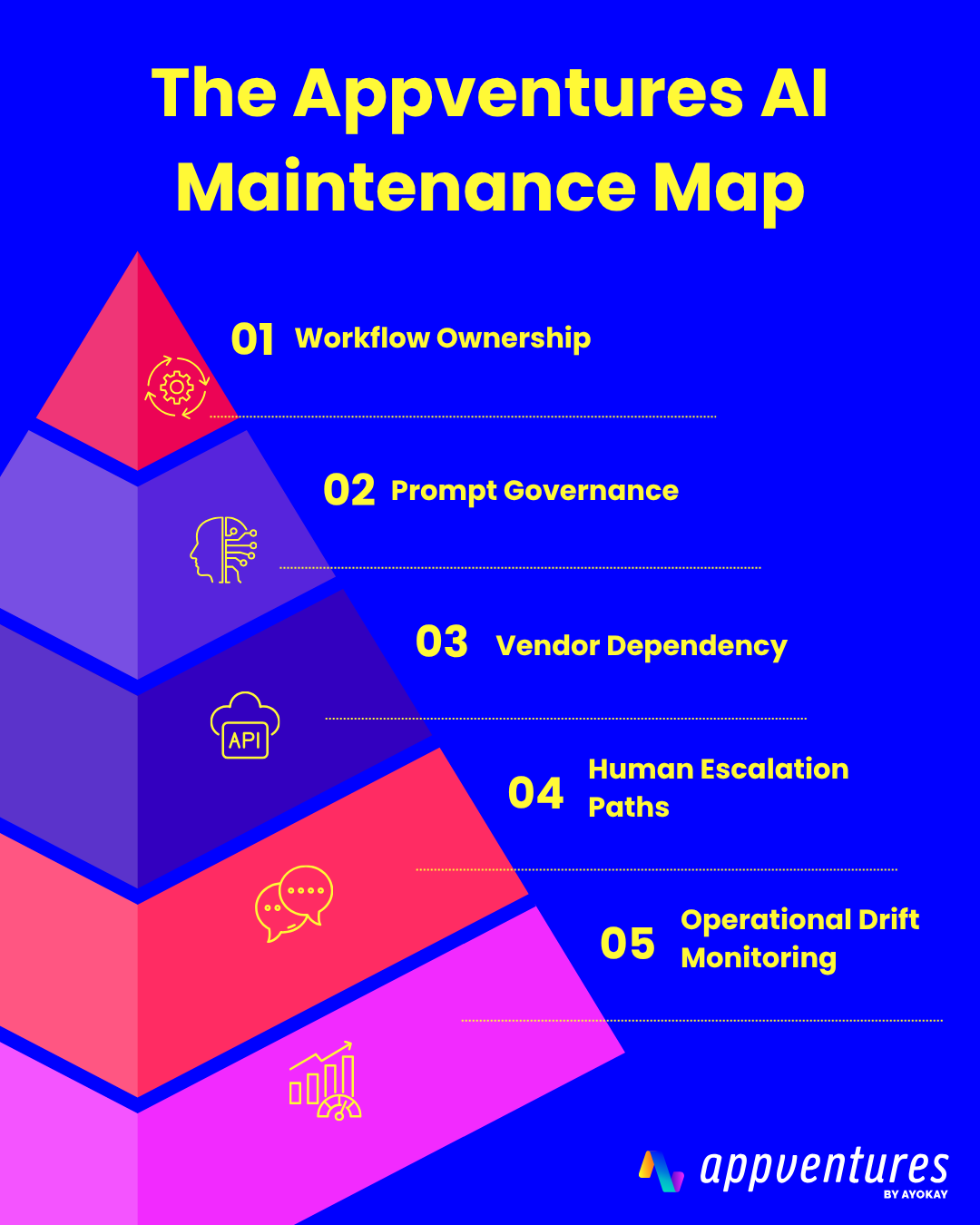
The Appventures AI Maintenance Map
AI conversations often focus heavily on deployment while long-term maintenance systems receive far less attention.That operational gap is where long-term risk begins to accumulate.
The Appventures AI Maintenance Map helps identify where AI systems begin to lose reliability, visibility, and operational stability over time.
Layer 1: Workflow Ownership
- Who owns the workflow?
- Who approves changes?
- Who monitors degradation?
Layer 2: Prompt Governance
- Where are prompts stored?
- Who can modify them?
- Are prompt changes documented?
Layer 3: Vendor Dependency
- Which systems rely on third-party AI vendors?
- What happens if pricing or models change?
- What backup processes exist?
Layer 4: Human Escalation Paths
- When does AI hand work to humans?
- Who reviews failures?
- How are corrections tracked?
Layer 5: Operational Drift Monitoring
- Are outputs becoming less reliable?
- Are employees bypassing workflows?
- Is manual correction increasing?
This is the difference between “using AI” and operating AI responsibly.
A Quick C-Suite Triage Checklist
Before the end of the day, ask your CIO, VP of Engineering, or technology leadership these three questions:
1. Who owns each AI-powered workflow we depend on today?
Every business-critical AI system should have clear operational ownership. If accountability is unclear, reliability usually becomes unclear as well.
2. How would we know if one of our AI systems started producing lower-quality outputs tomorrow?
Many organizations monitor uptime and usage. Fewer monitor output quality, operational drift, or employee trust in AI-generated results.
3. What happens if a critical AI vendor changes pricing, policies, or model behavior next month?
Understanding vendor dependencies helps reveal how much operational risk exists beneath systems that currently appear stable.
If these questions are difficult to answer, your AI technical debt may already be growing faster than your governance processes can manage.
The Real Risk Is Operational Trust Erosion
Most executives still think AI failure looks dramatic. It usually doesn’t. AI technical debt creates a slow, invisible operational decay.
Employees quietly stop trusting outputs. Departments build hidden, manual workarounds. Decision-making slows to a crawl as everything is double-checked. Leadership completely loses visibility into process reliability. Eventually, your operational efficiency declines while the systems themselves still appear advanced on the surface.
That is the real danger.
AI Systems Do Not Stay Healthy on Their Own
Every AI feature added to a workflow eventually becomes part of the operational infrastructure behind the business.
Infrastructure without ownership eventually becomes unstable.
Sustainable advantage in 2026 will come from operational systems that can govern, maintain, and adapt AI responsibly over time.
AI technical debt rarely stays contained inside engineering for long. Over time, it begins to affect workflows, customer experience, reporting accuracy, decision-making, and financial performance.
Those who ignore this now may spend the next several years untangling automated bad habits that were mistaken for innovation.
Find the AI Systems Your Organization Is Losing Control Over
Most companies already have AI technical debt hiding inside workflows they assume are stable.
Appventures doesn’t believe in over-engineering solutions to operational drift. We help organizations run a lightweight, non-invasive AI Rapid Health Check. Think of it as a preventative scan for your digital infrastructure. We identify hidden prompt fragmentation, fragile third-party dependencies, and silent operational drift—giving you a clear, prioritized map of what to secure, what to maintain, and what to leave alone.
If your AI roadmap has grown faster than your operational oversight, this is the right time to audit the systems before the problems scale further. Don’t let automated bad habits look like innovation. Let’s run a quick scan, isolate your hidden liabilities, and get your AI infrastructure back under your total control.
👉 [Schedule a 15-Minute AI Rapid Health Check with Appventures]
FAQ
Frequently Asked Questions About AI Technical Debt
What is AI technical debt?
AI technical debt refers to the long-term operational complexity and maintenance burden created by AI systems, workflows, prompts, integrations, and model dependencies.
Why does AI technical debt grow faster than traditional technical debt?
AI systems change continuously due to evolving models, prompt drift, data variability, employee usage patterns, and third-party vendor updates.
What causes AI technical debt?
Common causes include:
- Lack of governance
- Undefined ownership
- Poor prompt management
- Rapid AI deployment
- Vendor dependency
- Missing monitoring systems
How do you identify AI technical debt?
Warning signs include:
- Employees bypassing workflows
- Increasing manual corrections
- Unexplained output changes
- Low trust in AI systems
- Missing operational ownership
What is prompt drift?
Prompt drift happens when prompts evolve over time through undocumented edits, inconsistent usage, or workflow changes that alter AI behavior unpredictably.
Why is AI governance important in 2026?
AI systems are becoming more deeply embedded across operations, customer experience, reporting, and internal workflows. Governance helps reduce operational instability and long-term business risk.
What is the AI Integration Tax?
The AI Integration Tax refers to the hidden operational costs of maintaining AI systems after deployment, including monitoring, governance, workflow management, security reviews, and human oversight.
How can companies reduce AI technical debt?
AI technical debt can be reduced by:
- Assigning workflow ownership
- Documenting prompts
- Monitoring operational drift
- Creating escalation paths
- Auditing vendor dependencies
- Tracking business impact instead of usage metrics













Tell Us About Your Operational Challenges