


Blog

- Jack Shepler
- Jun 01, 2026
Many companies struggle with prioritization because too many initiatives move forward without being questioned or removed. A product roadmap kill list introduces a different kind of discipline, guiding decisions toward what truly deserves investment, especially when every feature competes for the same limited engineering time, budget, and attention.
When every initiative on a roadmap feels valuable, it often signals that decisions are being deferred rather than evaluated with clear criteria and accountability.
A strong roadmap reflects a set of financial bets with defined expectations and measurable outcomes, where each initiative earns its place and anything that falls short is intentionally removed through a structured kill list approach.
What Is a Product Roadmap Kill List (And Why You Need One)
A product roadmap kill list is a structured way to eliminate low-impact features, projects, or initiatives that don’t meet a defined ROI threshold, so resources can be redirected toward work that actually drives measurable results.
Most roadmaps expand over time, with new ideas added and very few removed, which spreads resources thin and makes meaningful progress harder to achieve.
This discipline introduces constraints that bring focus back into the process:
- Every initiative must justify its existence
- Every feature is evaluated against measurable outcomes
- Every quarter includes intentional decisions about what to remove
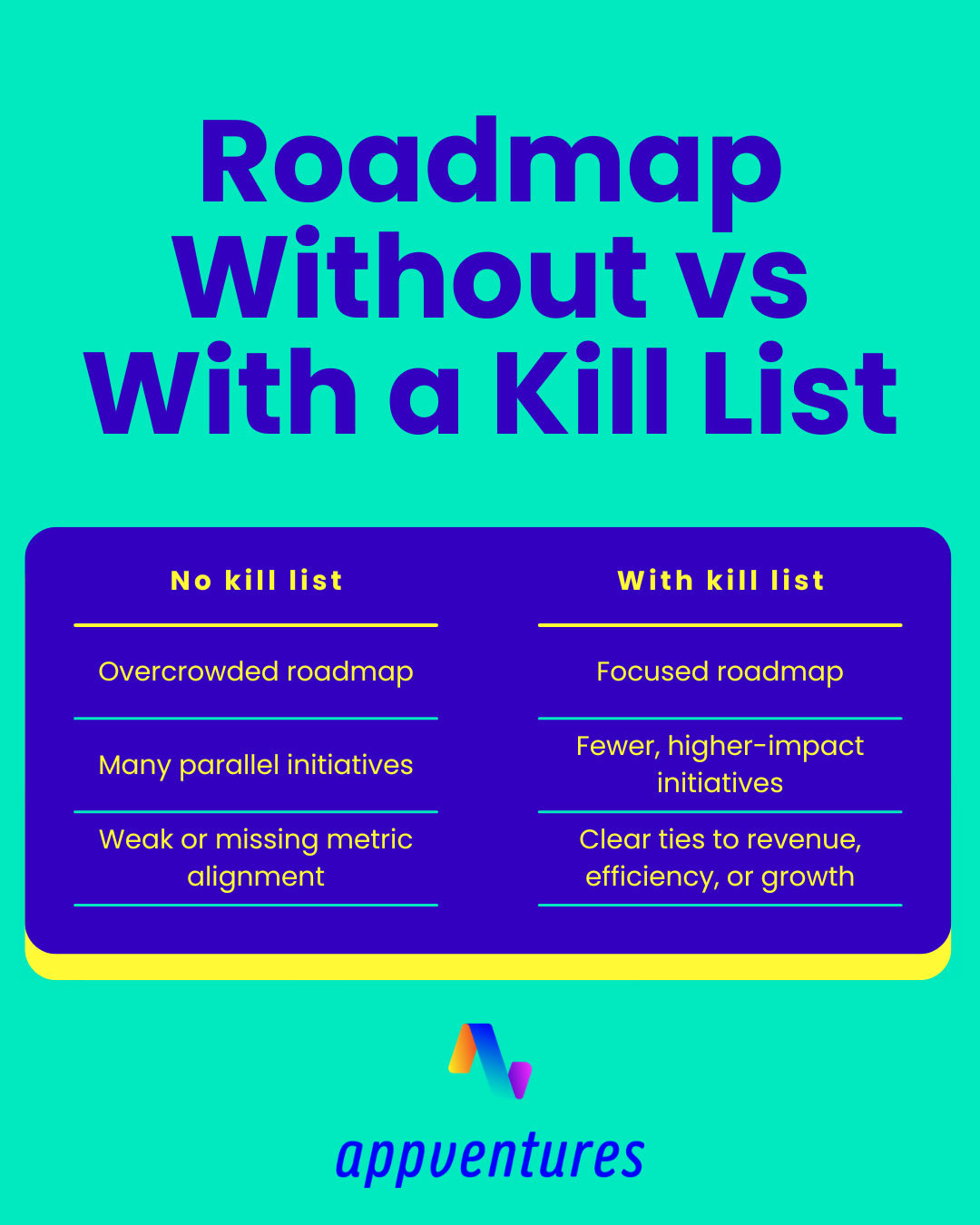
The result is a concentrated set of initiatives with direct ties to revenue, efficiency, or growth, supported by clearer success metrics and faster decision cycles.
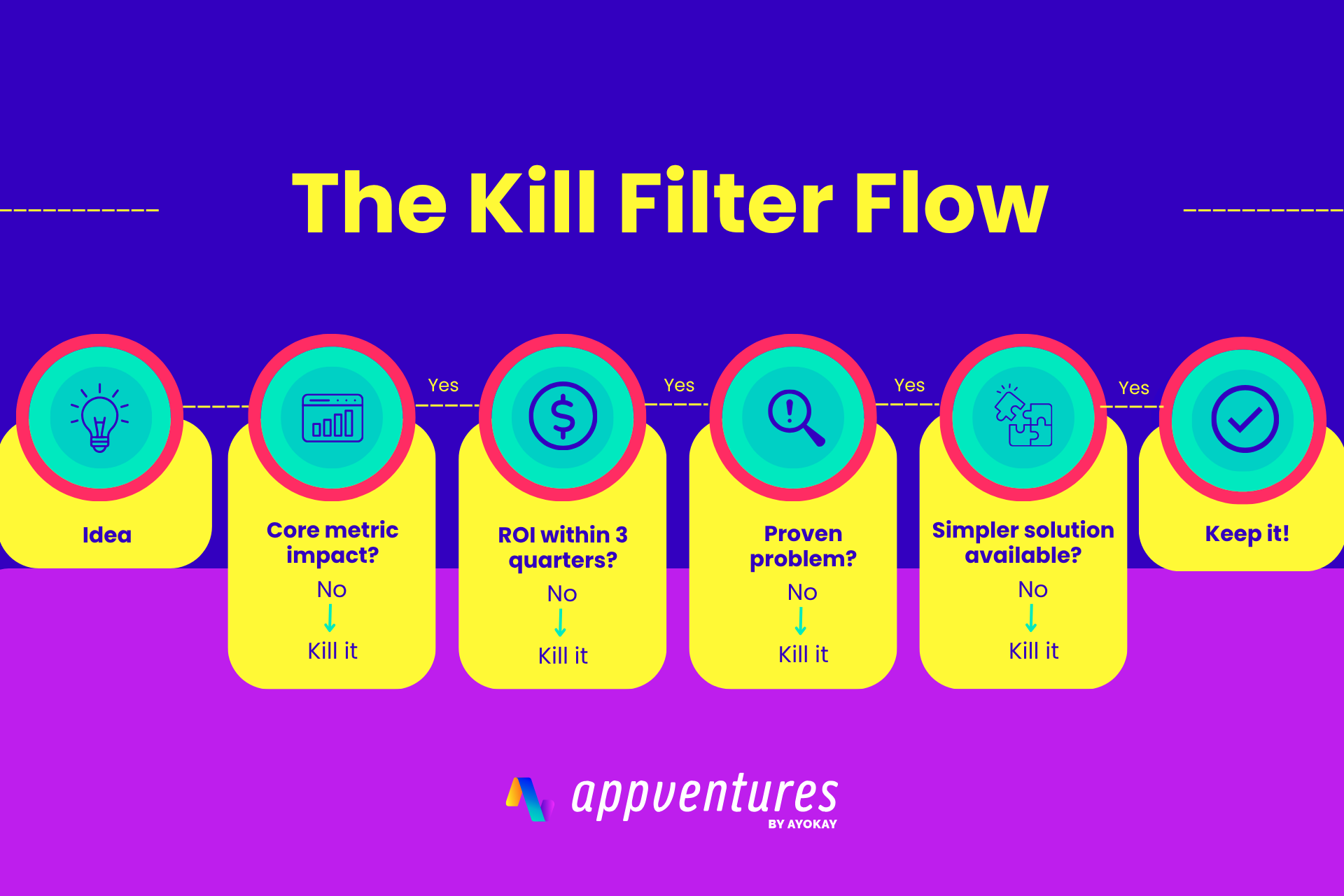
The 5 Questions Every Kill List Should Include
1. Does This Initiative Impact a Core Business Metric?
If it doesn’t move revenue, reduce cost, improve retention, or increase conversion, it is not a priority.
This framework starts by filtering out anything that cannot be tied to a measurable business outcome.
2. Can We Estimate ROI Within 3 Quarters?
When payoff timelines are unclear or extend too far out, the initiative shifts into exploration territory rather than structured product investment.
Clear timelines introduce accountability and make it easier to compare initiatives when allocating resources.
When an initiative shows a defined path to impact within a reasonable timeframe, it becomes a stronger candidate for focused execution.
3. What Happens If We Don’t Build This?
This question surfaces urgency that is often assumed rather than validated.
If the answer suggests minimal impact, the initiative rarely justifies a place on the roadmap.
4. Is This Solving a Proven Problem or a Hypothetical One?
Features built on assumptions or internal preferences tend to consume disproportionate resources compared to the value they return.
This discipline prioritizes validated problems with clear signals of demand.
5. Is There a Simpler, Cheaper Way to Solve This?
Before committing to custom development, evaluate whether the problem can be addressed through process improvements, existing tools, or lightweight automation.
This step prevents early overengineering and ensures development effort is used where it creates real leverage.
When simpler solutions reach their limits or stop scaling, custom development becomes a strategic next step with clearer requirements and stronger validation.
What Survives the Kill List Discipline
What remains is a concentrated set of initiatives with direct ties to revenue, efficiency, or growth, supported by clearer success metrics and faster decision cycles.
These initiatives are easier to prioritize, easier to defend, and easier to execute because they are grounded in validated outcomes rather than assumptions.
This is where product development becomes more effective, with resources focused on work that meaningfully moves business performance.
The Discipline Most Roadmaps Avoid
A kill list introduces a level of discipline that most organizations acknowledge in theory but struggle to maintain in practice, because it requires consistent tradeoffs and a shared standard for what qualifies as meaningful impact.
It creates tension in the right places, especially when initiatives that feel important cannot demonstrate a clear connection to business outcomes, or when long-standing ideas fail to justify continued investment.
It also breaks the pattern of accumulation, where roadmaps grow without subtraction, by requiring every addition to compete against removal decisions.
This shifts product conversations toward measurable impact and exposes how many initiatives are built on assumptions rather than validated needs.
How to Operationalize a Kill List
A product roadmap kill list works best when it becomes part of an ongoing decision-making system rather than a one-time exercise.
In practice, this requires a consistent evaluation framework that connects business priorities to product decisions and applies the same standard across all initiatives.
- Run a kill review before every planning cycle
- Require every initiative to pass all 5 questions
- Assign ownership for defending ROI assumptions
- Track post-launch impact against initial expectations
This level of discipline requires alignment across stakeholders and a willingness to apply the same evaluation standard across competing priorities.
When applied consistently, it produces a roadmap that is easier to manage and significantly more likely to deliver measurable results.
Conclusion
A roadmap filled with ideas can feel productive, yet real progress comes from concentrating effort on the initiatives that deliver measurable outcomes.
A kill list brings focus into the system by ensuring every initiative earns its place and resources are directed toward work with clear impact.
The goal is focused ambition applied to fewer, better-defined investments that move the business forward with greater clarity and confidence.
Build What Would Move Your Business
Most roadmaps run into trouble not from a shortage of ideas, but from the steady accumulation of work that moves forward without a clear sense of impact.
At Appventures, we help organizations apply a kill list mindset to product decisions, identify high-impact opportunities, and build systems tied directly to measurable business outcomes.
Let’s focus your roadmap on the work that actually moves revenue, efficiency, and growth.
FAQ
What is a product roadmap?
A product roadmap is a structured view of the initiatives a company plans to pursue over time, used to align product, engineering, and business priorities around expected outcomes and timelines.
In practice, it reflects a portfolio of prioritized bets about where time and resources will be invested, and it becomes most effective when each initiative is tied to measurable business impact such as revenue growth, cost reduction, or customer retention.
A product roadmap is most valuable when treated as a system for decision-making rather than a static list of planned features.
How do you build a product roadmap kill list?
A kill list is built by defining a consistent evaluation framework that every initiative must pass before approval, typically including ROI timeline, business impact, problem validation, and execution efficiency.
Why is a product roadmap kill list important?
It prevents resource dilution by ensuring low-impact initiatives are removed before consuming engineering time, budget, or strategic focus, improving clarity and execution quality.
How do you decide what to remove from a roadmap?
Initiatives are evaluated based on business impact, ROI clarity, validation strength, and whether simpler solutions already exist. Items that fail these criteria are removed or deprioritized.
What happens if low-priority features are not removed?
Roadmaps become fragmented, delivery slows, and resources are spread across initiatives that do not materially improve business outcomes.
How often should a roadmap be reviewed?
Before every planning cycle, typically quarterly, to ensure alignment with business goals and to continuously remove low-impact work.


















Tell Us About Your Operational Challenges