


Blog

- Jack Shepler
- May 07, 2026
A Salesforce integration strategy is often treated as a technical exercise, but in practice it begins much earlier, with decisions that feel reasonable in the moment: connecting another tool to improve visibility, automating another sync to reduce manual work, or integrating a platform because it is technically possible.
Most Salesforce environments don’t become complex through intentional decisions. Complexity develops gradually through small, repeated choices like these.
At scale, these choices stop being isolated improvements and start becoming part of the revenue system itself.
And every system connection begins to influence something far more important than data flow. It directly shapes revenue velocity.
A Salesforce integration strategy focuses on how information moves through the revenue engine while avoiding friction that slows decisions, distorts reporting, or erodes trust in the system.
The strongest revenue setups evaluate integrations by identifying the friction they introduce and assessing whether that friction is justified by the value it creates.
WHAT THIS FRAMEWORK COVERS
Before evaluating individual integrations, it is important to understand the decision lens this article applies. Each section focuses on identifying where revenue friction is introduced and how it compounds inside a Salesforce environment.
This Salesforce integration strategy framework covers:
- How integrations quietly introduce revenue friction instead of efficiency
- Why real-time sync is often a liability rather than an upgrade
- How to evaluate integration ROI through a friction-based model
- The Appventures Integration Kill-Chain for detecting system risk early
- How data ownership defines whether your CRM remains trustworthy or becomes fragmented
- Why every integration ultimately acts as a tax on revenue velocity
To bring more consistency to integration decisions, it is useful to evaluate them through a structured sequence rather than isolated judgment calls. The sections below are numbered intentionally, each one building on the last to surface whether an integration improves revenue flow or introduces hidden friction into how the system operates at scale.
WHERE REVENUE FRICTION ENTERS THE SYSTEM
1. When integrations stop improving flow and start creating friction
Integrations begin as improvements, but over time they often become sources of operational drag.
The early signs are rarely technical. They show up in day-to-day behavior:
- Revenue teams stop trusting Salesforce as a reliable source of truth
- Reports require explanation before they can be used
- Multiple systems overwrite the same fields without clear hierarchy
- Manual workarounds emerge to correct automated behavior
- Data discrepancies become a normal part of operations rather than exceptions
When this happens, the integration stops accelerating the system and begins introducing friction into how decisions are made.
At this stage, the cost extends beyond data inconsistency and shows up in slower revenue execution, where every decision requires validation instead of confidence.
A Salesforce integration strategy works when it reduces friction in decision-making and improves the reliability of how the system supports execution.
2. When real-time sync becomes a liability instead of an advantage
Real-time synchronization is often treated as an automatic upgrade. In reality, it can introduce continuous system tension where it is not required.
The question shifts from whether real-time sync is possible to whether it improves revenue decisions.
In many cases, it does not.
Manual sync is often more effective when:
- Data changes are infrequent but high-impact, such as pricing or contracts
- Accuracy matters more than immediacy
- Source systems already enforce strong validation before data entry
- The purpose of Salesforce is reporting or visibility rather than execution
In these scenarios, real-time integration does not improve outcomes and instead increases system fragility while creating the appearance of improved efficiency.
A mature Salesforce integration strategy focuses on decision reliability under operational pressure rather than optimizing for automation by default.
3.Integration ROI as a friction equation rather than an efficiency metric
Most integrations are evaluated as productivity improvements. A more accurate lens is friction.
Every integration introduces both value and cost, but the cost is often distributed across the system in less visible ways.
A more realistic model looks like this:
Integration value = friction removed − friction introduced
Friction includes:
- Ongoing maintenance and monitoring
- Failure risk and recovery effort
- Data reconciliation across systems
- Loss of trust in reporting accuracy
- Increased dependency between platforms
- Operational ambiguity when systems disagree
If the primary benefit is “better insight,” the next question is whether that insight changes decisions in a measurable way.
If it does not, the integration is likely redistributing friction rather than removing it.
4. The Appventures Integration Kill-Chain: preventing revenue system pollution
Not every integration failure shows up as a technical error. Many of the most damaging ones appear later, in the form of degraded trust, inconsistent reporting, and slower decision cycles.
Before any system is connected to Salesforce, it should pass a structured evaluation designed to determine whether it introduces data pollution into the revenue engine.
At Appventures, this is evaluated through the Integration Kill-Chain, a sequence that determines whether a proposed connection strengthens or contaminates the system.
Step 1: Revenue dependency test
If this integration stops working today, what breaks first?
- Nothing meaningful breaks → the integration is optional complexity
- Reporting becomes less convenient → the integration is informational, not operational
- Revenue execution is disrupted → the integration is structurally embedded in the revenue system
Step 2: Decision impact test
Does this integration change how decisions are made, or only how information is viewed?
If it only improves visibility without changing behavior, it is contributing to system noise rather than system intelligence.
Step 3: Data ownership test
Is there a clearly defined owner for every field this integration touches?
If multiple systems can write to the same data without hierarchy, the integration introduces conflicting definitions of reality.
Step 4: Failure cost test
When this integration fails, is there a loss of speed, accuracy, or confidence in decision-making?
If the failure is silent or only causes inconvenience, the integration is not revenue-critical, regardless of how useful it appears.
Interpretation: the data pollution threshold
An integration that fails any step in the Kill-Chain is not neutral. It actively increases data pollution risk inside Salesforce.
Data pollution refers to the presence of competing truths across systems that gradually degrade revenue execution over time.
A mature Salesforce integration strategy focuses on selectively connecting systems that strengthen revenue clarity while avoiding those that introduce ambiguity into decision-making.
Decision Flow: The Integration Kill-Chain in Practice
The Kill-Chain can also be applied as a simple decision flow when evaluating whether an integration should exist at all.
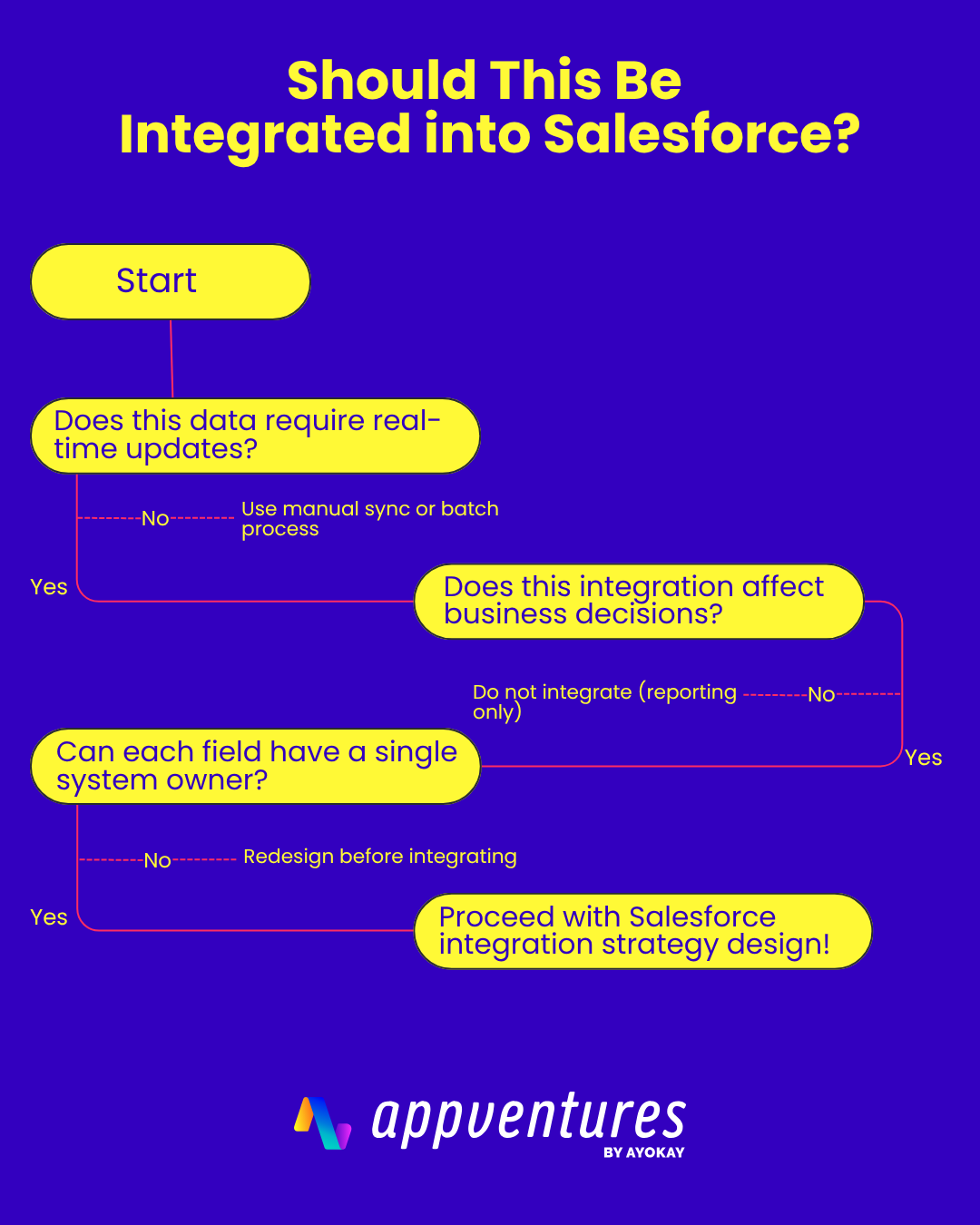
If any step introduces uncertainty, the integration should be redesigned before it enters Salesforce.
5. The source of truth rule and control of revenue reality
At scale, the primary risk shifts from integration itself to conflicting authority over data.
Every field in Salesforce represents a definition of reality.
And every definition of reality must have clear ownership:
- One system creates the data
- One system updates the data
- One system defines what “correct” means
When multiple systems write to the same fields without explicit ownership, the result is ambiguity rather than flexibility.
And ambiguity in revenue systems slows decision-making, weakens trust in reporting, and forces constant validation before action.
Over time, this reduces revenue velocity even when the underlying data appears technically accurate.
Every Integration Is a Tax on Revenue Velocity
A mature Salesforce environment is defined by strict filtering of integrations based on whether they deliver a 10x return in revenue velocity, clarity, or execution speed.
A Salesforce integration strategy is built around control, focusing on data ownership, system responsibility, and how revenue information flows through the organization.
At scale, every integration carries cost: maintenance, failure risk, and added complexity. Each one functions as a tax on system speed and reliability.
Some integrations earn that cost by improving revenue outcomes. Others slowly degrade decision-making and trust in the system.
A strong strategy ensures only high-leverage integrations are added, while everything else is rejected before it introduces friction.
The real question is simple:
Does this reduce friction in the revenue system, or add to it?
LET’S DESIGN YOUR SALESFORCE INTEGRATION STRATEGY PROPERLY
As Salesforce ecosystems expand, conflicting data, slower reporting cycles, and reduced trust in the system often emerge from accumulated friction across integrations that were never designed as part of a unified revenue system.
Appventures helps design and refine Salesforce integration strategies so every system connection supports revenue velocity rather than degrading it over time.
We focus on:
- Identifying where friction is being introduced into revenue workflows
- Clarifying system ownership across tools and data layers
- Reducing unnecessary integration complexity without limiting capability
- Improving decision speed across revenue operations
If you want a second opinion on whether your current integrations are accelerating or slowing your revenue system, we can help you map that clearly.
FAQ
1. What is a Salesforce integration?
A Salesforce integration is a connection between Salesforce and another system that moves data between them. If it is not intentionally designed, it is architectural debt that will compound over time and cost up to 10x more to unwind than it did to implement.
2. When should a Salesforce integration be avoided?
A Salesforce integration should be reconsidered when it does not improve a critical revenue workflow, when accuracy matters more than real-time updates, or when it introduces uncertainty in data ownership.
3. What is the biggest mistake in Salesforce integration strategy?
The most common mistake is allowing multiple systems to update the same data fields without clear ownership, creating conflicting versions of operational truth.
4. Is manual sync ever better than integration?
Yes. Manual sync is often more stable when data changes are infrequent, validation is important, or real-time updates do not meaningfully improve decision-making.
5. How do you know if an integration is worth building?
An integration is worth building when it improves a specific revenue workflow, reduces measurable operational friction, and has clearly understood maintenance and failure costs.
















Tell Us About Your Operational Challenges